
SPEC-152-Q5b: Adviser Review View (Design Only)
Capability: SUITABILITY-ENGINE · Status: draft Repo: suitability-engine
This is a design specification and wireframe only. Per the 2026-08-16 scope decision: WTP does not build, host, or embed this UI anywhere — Origo’s own adviser-facing product implements it, if and how they choose, against the data this engine already produces. This document exists so that decision is made from a concrete design, not a vague intention.
1. Why this is a distinct surface from the client view
Section titled “1. Why this is a distinct surface from the client view”SPEC-004 describes the client’s view — polished, narrative, progressive-disclosure. An adviser needs the opposite: a dense, professional, audit-oriented view of the same derivation, used to review and sign off a report before the client ever sees it. Conflating the two (e.g. just giving an adviser the client view plus a “confirm” button) throws away exactly the information a professional reviewer needs — which rule produced which value, from which inputs, and where each of those inputs is sourced from.
2. Wireframe
Section titled “2. Wireframe”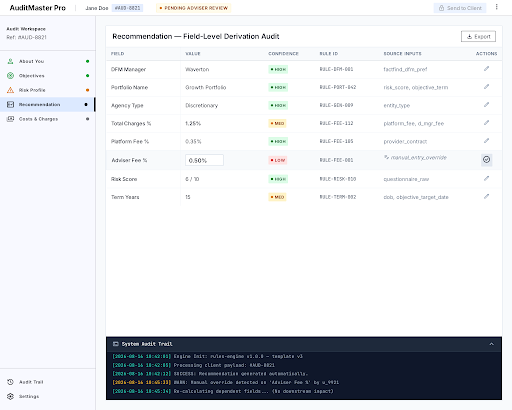
Generated as a design reference (not implemented code) via Stitch. Shows the “Recommendation” section selected; the same table pattern applies to every section.
Key elements:
- Top bar — client identity, a review-status pill, a “Send to Client” action that is deliberately hard to trigger accidentally (locked/greyed until review is actually complete — mirrors the client view’s “disabled until required sections viewed” gate, but for the adviser’s own review completeness, not the client’s).
- Left rail — one entry per report section, each with a status dot (not-reviewed / needs-attention / clear) so an adviser scanning many reports in a queue can see at a glance which need work.
- Main panel — a dense field-level table, not narrative cards: Field / Value / Source Class / Auto-sourceable / Rule ID / Source Inputs / Actions. This is the derivation audit trail made legible to a human reviewer. (The wireframe image predates the #14 decision and still shows a single graded “Confidence” column — read that column as the two categorical columns above; see §3. Regenerating the image is tracked in #64.)
- Audit trail footer — a raw, timestamped system log (engine version, template version, override events) for the rare case a reviewer needs the literal record, not just the summarised table above it.
3. Data mapping — and what “confidence” actually means here
Section titled “3. Data mapping — and what “confidence” actually means here”The table’s core columns map to DerivationAuditEntry
(src/suitability-rules/types.ts), returned as part of the audit object
in POST .../suitability/export?format=json’s response ({ data, audit })
— already returned today, and currently unused by the client view spec,
since a client should never see raw rule IDs or source-field names:
| Wireframe column | Source |
|---|---|
| Field | DerivationAuditEntry.fieldPath |
| Value | DerivationAuditEntry.output |
| Rule ID | DerivationAuditEntry.ruleId |
| Source Inputs | DerivationAuditEntry.inputs (keys) |
| Source Class | FieldTraceEntry.sourceClass (src/suitability-readiness/trace.ts) |
| Auto-sourceable | FieldTraceEntry.autoSourceable |
There is no graded “Confidence” column — by decision, not omission.
Grounding the original wireframe in the real API showed that the
High/Medium/Low “Confidence” badge it drew does not correspond to anything
the engine computes. SPEC-152’s prose (“RAG confidence travels with every
field”) overstated what exists (amendment tracked in
client-onboarding#2808). What is actually implemented
(suitability-readiness/trace.ts’s FieldTrace) is, per template
variable:
- a categorical
sourceClass—Enable | Holdings | Spreadsheet | Calc | Config | Manual | New | Unknown— naming where that variable’s value comes from; and - an
autoSourceableboolean — whether the engine can populate it without manual input.
Decision (#14,
Rob, 2026-09-30 — Option A): drop the numeric/graded confidence concept.
An adviser view shows sourceClass and autoSourceable directly, as
what they are — no mapping onto a 3-tier badge (e.g. autoSourceable: true → “High”) that would imply more precision than the data carries. No
engine change is needed; both fields are already produced.
Two caveats anyone building this for real still needs:
FieldTraceis template-level, not client-level. It describes which variables a template uses and where each is sourced from — it is the same for every client rendered against that template. It says nothing about the quality of a specific client’s derived value.FieldTraceandDerivationAuditRecordare not currently joined anywhere in this codebase.FieldTraceoperates on a parsed template;DerivationAuditRecordoperates on a specific client’s derived values. Putting both on one table row means joining them by field path/variable name in the consuming UI (or a future engine helper) — straightforward, but not a lookup that exists today.
Graded per-value scoring (joining the two and grading each client’s value) is not planned; revisit only if an adviser reviewer workflow shows the categorical signal is genuinely insufficient.
4. What this spec deliberately does not include
Section titled “4. What this spec deliberately does not include”- No working reference implementation (unlike SPEC-004) — the 2026-08-16 scope decision was design spec + wireframe only for this surface, since WTP will never operate it.
- No auth/session model — Origo’s adviser authentication is entirely their own concern; this engine has no adviser-identity concept at all.
- No “Override” persistence design — the wireframe shows an Override action per row (an adviser correcting a derived value before send) but this spec does not design where that override is stored, how it re-enters the pipeline, or how it’s audited. A real implementation needs that design; it’s flagged as follow-up scope, not solved here.
- No multi-report queue/worklist UI — the wireframe shows one report’s review state; a real adviser tool almost certainly needs a list view across many clients, entirely out of scope here.
5. Traceability
Section titled “5. Traceability”- Companion: SPEC-004 (client view)
- Data source:
src/suitability-rules/types.ts(DerivationAuditEntry),src/suitability-readiness/trace.ts(FieldTrace) - Feeds: any future Origo-side adviser tooling decision — not a WTP build item